

Furrow application:
Protection of the potato crop from the beginning of cultivation

Application of biological inputs during potato planting in furrows
Potato cultivation relies on highly technical production systems , where planting, the application of treatments and agronomic management are part of a highly standardized operation.
In this context, the incorporation of new phytosanitary tools depends mainly on their effectiveness , but their ability to be practically integrated into the procedures that the farmer already uses in the field, without the need to modify existing machinery or equipment, is also key.
Therefore, when we talk about biological plant protection products based on microorganisms, one of the most important questions is how to introduce them into the production system without complicating cultivation practices . In potato cultivation, furrow application during planting is precisely one of the most promising ways to achieve this.
This strategy allows us to take advantage of a technique already implemented in many farms to incorporate microorganisms for disease control from the beginning of the crop cycle, without the need to add new passes, complementary machinery or significant changes in the organization of work.
From this point of view, in-furrow application is not only a way to apply a product, but also a way to integrate new biological tools into an already established production system.
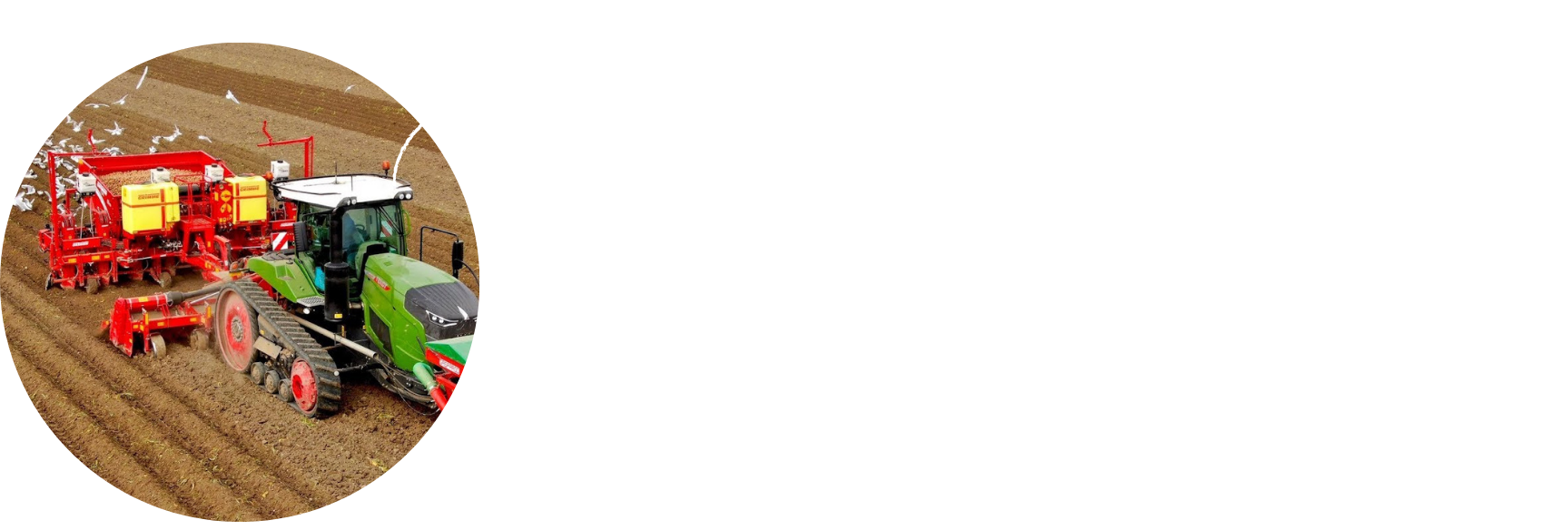
Resilience in potato cultivation is not an isolated quality, but the result of a systemic construction. It can be summarized in a simple equation:
The importance of applying plant protection products at the right time
Each microorganism has different characteristics, acts with different mechanisms of action, and has its own life cycle, among other factors that determine the best time and the most appropriate method of application in each case.
Logically, one might assume that working with biological plant protection products would require changes to the farmer’s usual practices. However, in practice, the opposite is true: the application strategy of T34 Biocontrol® is designed to take advantage of one of the key operations in potato cultivation— in-furrow planting.
Unlike many chemical treatments, whose effect occurs mainly at the moment of application, T34 Biocontrol® needs to colonize the root environment. It establishes itself in the rhizosphere as a protective layer that persists over time, helping to protect the plant against various pathogens. In potato cultivation, the main target is Rhizoctonia solani.
A strategy that protects the crop from the start
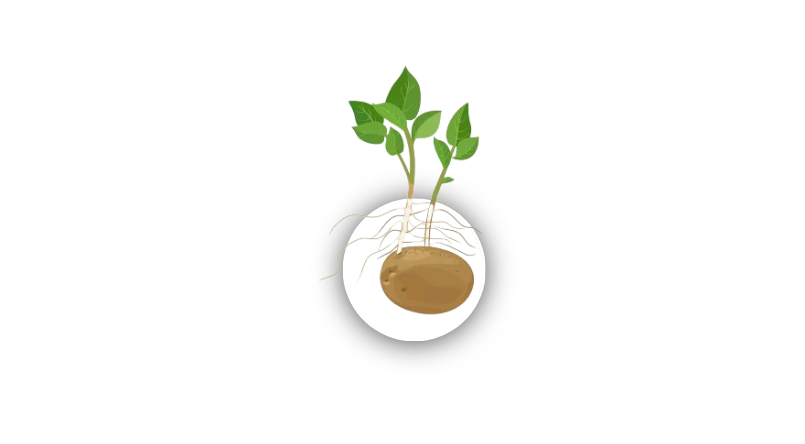
For this reason, introducing them from the earliest stages of cultivation can make a significant difference. In the case of potatoes, the planting time presents a particularly interesting opportunity, as it allows the microorganism to be placed directly in the tuber’s environment even before the plant emerges .
Place the microorganism in the soil at the same point where the root system will begin to develop; in this way, the crop begins its cycle protected from the early stages of growth.
This moment is especially relevant from an agronomic point of view. The early stages of crop development are key; the root system is established and the interaction between young roots, soil microorganisms, and any pathogens present in the environment begins.
Establishment of T. asperellum in the root zone.
Unlike many chemical treatments, whose effect occurs mainly at the moment of application, T34 Biocontrol® needs to colonize the root environment. It establishes itself in the rhizosphere as a protective layer that persists over time, helping to protect the plant against various pathogens. In potato cultivation, the main target is Rhizoctonia solani.
The spores are quickly activated by water and begin to colonize the rhizosphere. Around the roots, the microorganism establishes itself and begins to protect the root system. In the microscopic image, the layer of the T34 strain of T. asperellum, the active ingredient of RootDei Biocontrol®, can be seen.

Competition for Space: one mechanism of action among others.
When the microorganism is introduced into the soil in the early stages of cultivation, it is able to quickly colonize the root environment and establish itself around the plant’s roots.
This colonization process creates a kind of natural biological barrier , in which the microorganism occupies the available space and consumes the resources present in the rhizosphere. As a result, the establishment of soil pathogens is hindered , as they find an already occupied environment with less available nutrients for their development.
However, it is important to understand that competition for space is not the only mechanism of action . Trichoderma can also act through other complementary processes, such as mycoparasitism against pathogens , the production of antifungal compounds , or the induction of systemic resistance in the plant .
Application of plant protection products during planting
Furrow application involves applying a treatment directly into the planting furrow at the time the tuber is placed in the field. In potato cultivation, this treatment is usually carried out using spray systems installed on the planter itself, which allow the product to be applied to the tuber and the surrounding soil before the furrow is closed.
This is a technique widely used in professional farms because it allows the treatment to be located exactly in the area where the root system will develop, thus optimizing the effectiveness of the application.
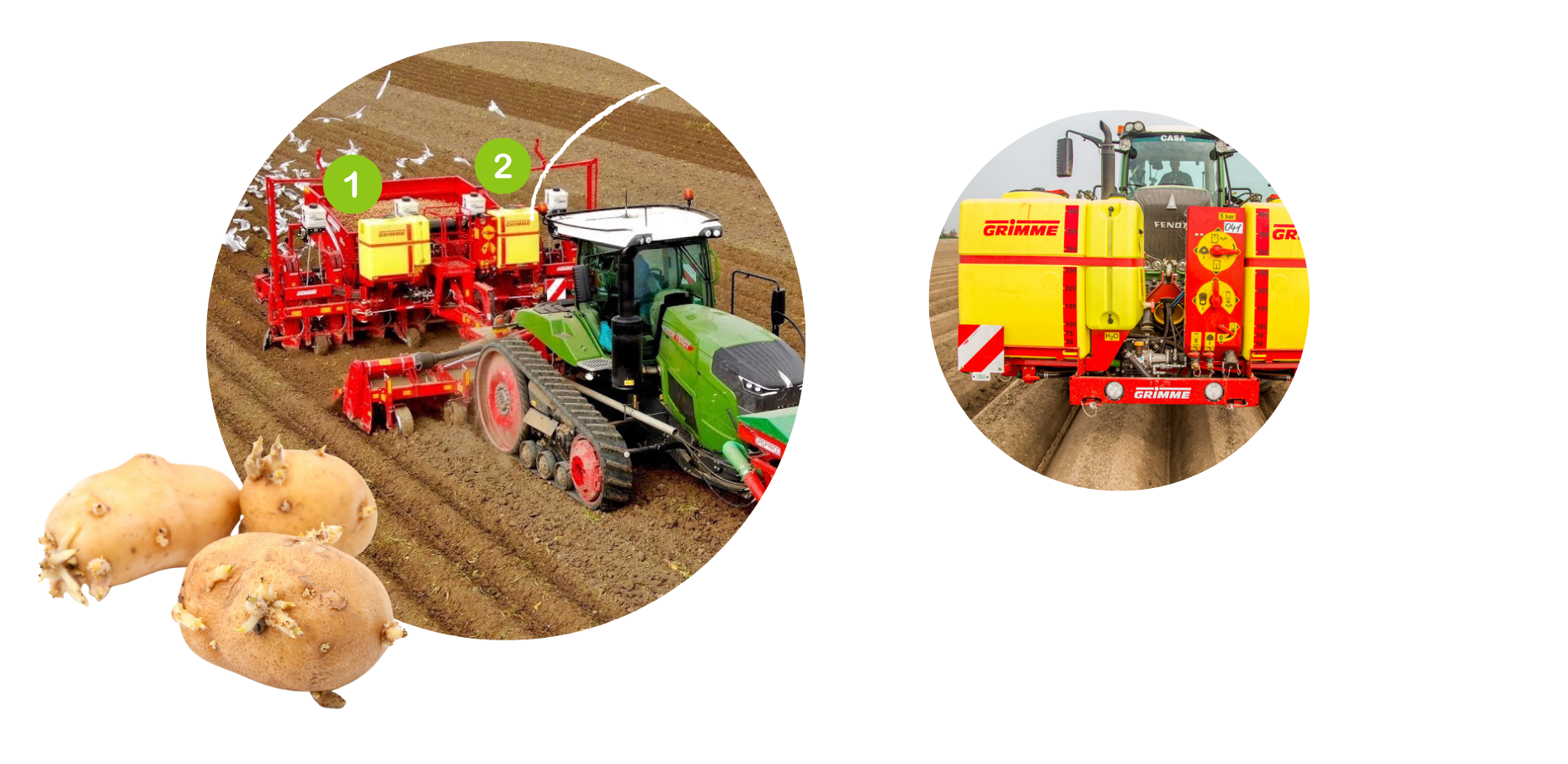
What is furrow cultivation?
Furrow cultivation is an agronomic management system in which the soil is organized into raised rows or ridges separated by channels or furrows. This design improves drainage , promotes soil aeration , and facilitates irrigation management. It is a highly technical system with standardized processes. This system also facilitates key agronomic operations, such as hilling, weed control, and the localized application of products during planting.
For these reasons, furrow cultivation is widely used in numerous extensive agricultural crops.
In the case of potatoes, row cultivation is of particular importance. The tubers are planted on top of the ridge, allowing the root system and future tubers to develop in looser, more aerated, and better-drained soil.

As with any localized treatment, aspects such as the distribution of the solution within the mixture, the volume of water used, or the type of spraying system can influence the final result of the application.
To better understand how this technique is implemented in real field conditions, it is useful to analyze the operation of the spraying systems installed on the planters.
In the technical video associated with this module, we will analyze in more detail how the application in furrow is carried out under real field conditions and what technical aspects should be taken into account during planting.
MODULE II. TECHNICAL VIDEO
Discover step by step how to correctly apply T34 Biocontrol® in the furrow during potato planting.
Input application system for row planters
In professional potato farming, many planters incorporate localized spray application systems that allow treatments to be applied directly into the furrow during the planting process. These systems typically include a spray circuit connected to a tank and a pump that feeds the sprayers installed in each planting row.
These systems are integrated into the machinery itself and apply the treatment at the moment the tuber is placed in the furrow, before it is closed by the ridge-forming elements.

For this system to work correctly in the field, it is important to understand how the machinery is configured and what technical aspects should be checked before starting the planting.
Elements such as the arrangement of the sprayers , the orientation of the nozzles , the type of nozzle used , the volume of mixture applied and above all knowing the maintenance status of the system can directly influence the way in which the treatment is distributed within the furrow.
• Understand the configuration of the planter's spraying system
• Prepare the pre-dilution of the product
• Know the mixing capacity and the type of liquid storage system
• Use the most suitable nozzles in each case
• Correctly position the spray nozzle(s)
• It does not replace proper agronomic management.
The following describes some of the most relevant technical aspects to consider when working with in-furrow application systems in potato planters:
Product Premix
Before adding the product to the planter’s tank, it is recommended to premix or pre-dilute it to ensure proper dispersion in the water. T34 Biocontrol® is formulated as a wettable powder (WP), which disperses easily in water.
To do this, you can use an auxiliary container with a small amount of water to which you have previously added the entire dose of product to be used in the final mixture. Then, stir the mixture for a few minutes until you obtain a homogeneous suspension , making sure that there are no lumps or accumulations of undissolved product.
This process can be done manually without difficulty and allows the product to be properly dispersed before being added to the main tank.
Cargo Depot
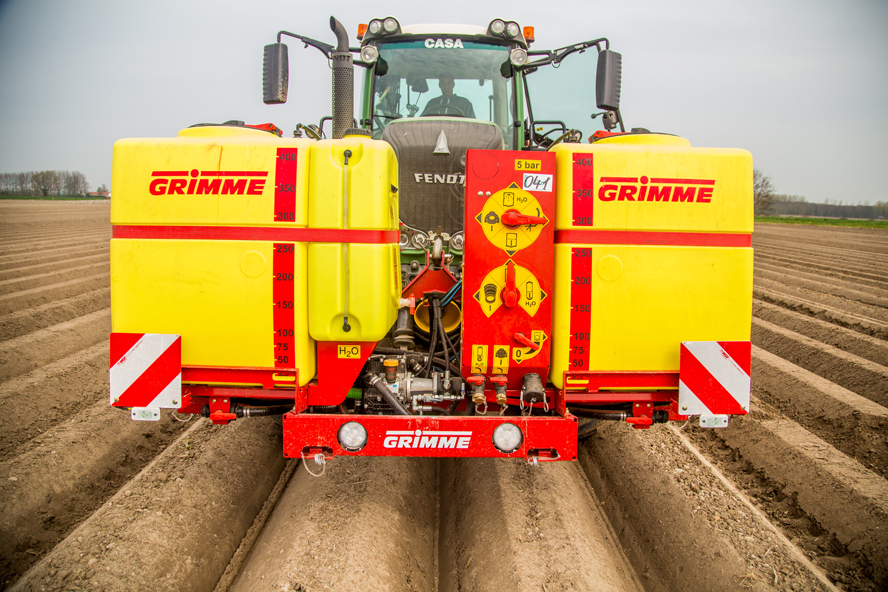
Once the premix has been added to the planter’s tank and the required volume of water has been filled, it is important to keep the tank’s agitation system running throughout the application process.
These agitation systems —which can be mechanical or hydraulic , depending on the type of equipment—are designed to keep the liquid moving within the tank. This ensures the product remains properly distributed in the mixture and prevents particles from settling at the bottom of the tank, which could lead to uneven application during fieldwork.
In addition to ensuring good agitation, it’s important to know the total capacity of the planter’s tank and properly plan the volume of mixture to be prepared for each load. This allows for a more accurate estimation of the area that can be treated with each tank and enables adjusting both the product dosage and water volume to the machine’s operating speed. In practice, this calculation depends on several factors, such as tank capacity, the spray system’s flow rate, and the planter’s forward speed. Knowing these parameters makes it easier to organize fieldwork, avoid unnecessary interruptions to refill the equipment, and ensure that the applied dose per unit area remains constant throughout the operation.
Spraying system configuration
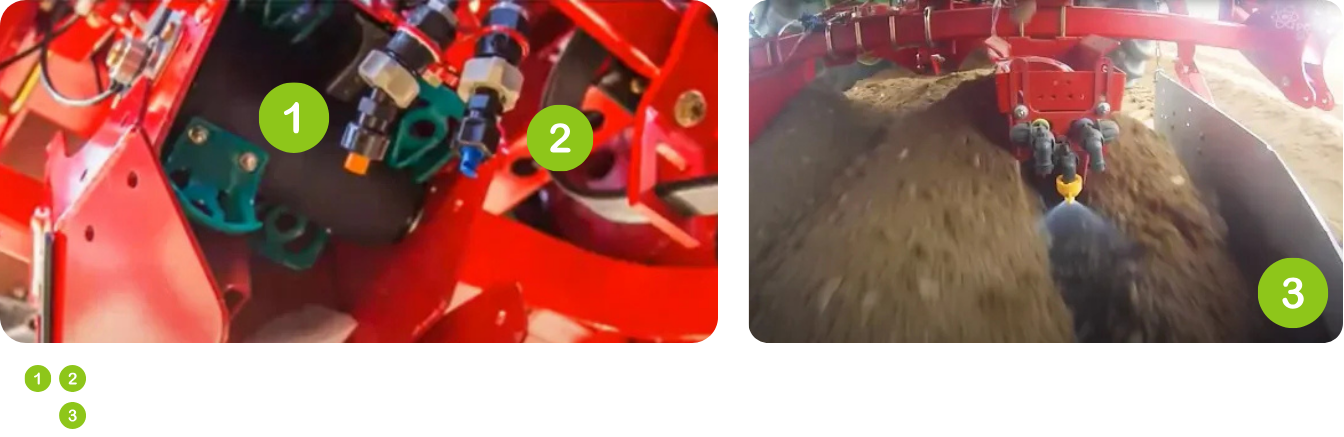
The sprayers are generally positioned just before the furrow closes , in a position that allows the treatment to be applied to both the tuber and the surrounding soil. Depending on the machine design, each row of plants may have one or more spray points .
In simpler setups, a single sprayer is used, centered over the furrow. More complex systems typically have two sprayers per row , directed from both sides of the furrow towards the tuber. This arrangement improves the distribution of the treatment within the soil surrounding the tuber.
Understanding how the planter’s spraying system is configured is essential to ensure that the treatment is correctly positioned in the planting line.
Incorrect orientation can cause some of the treatment to be deposited outside the desired area or result in insufficient coverage of the tuber. For this reason, it is advisable to check the position of the sprayers and their working angle before planting begins.
Types of Spray Nozzles
The type of nozzle used in the spraying system also influences the distribution of the treatment within the furrow.
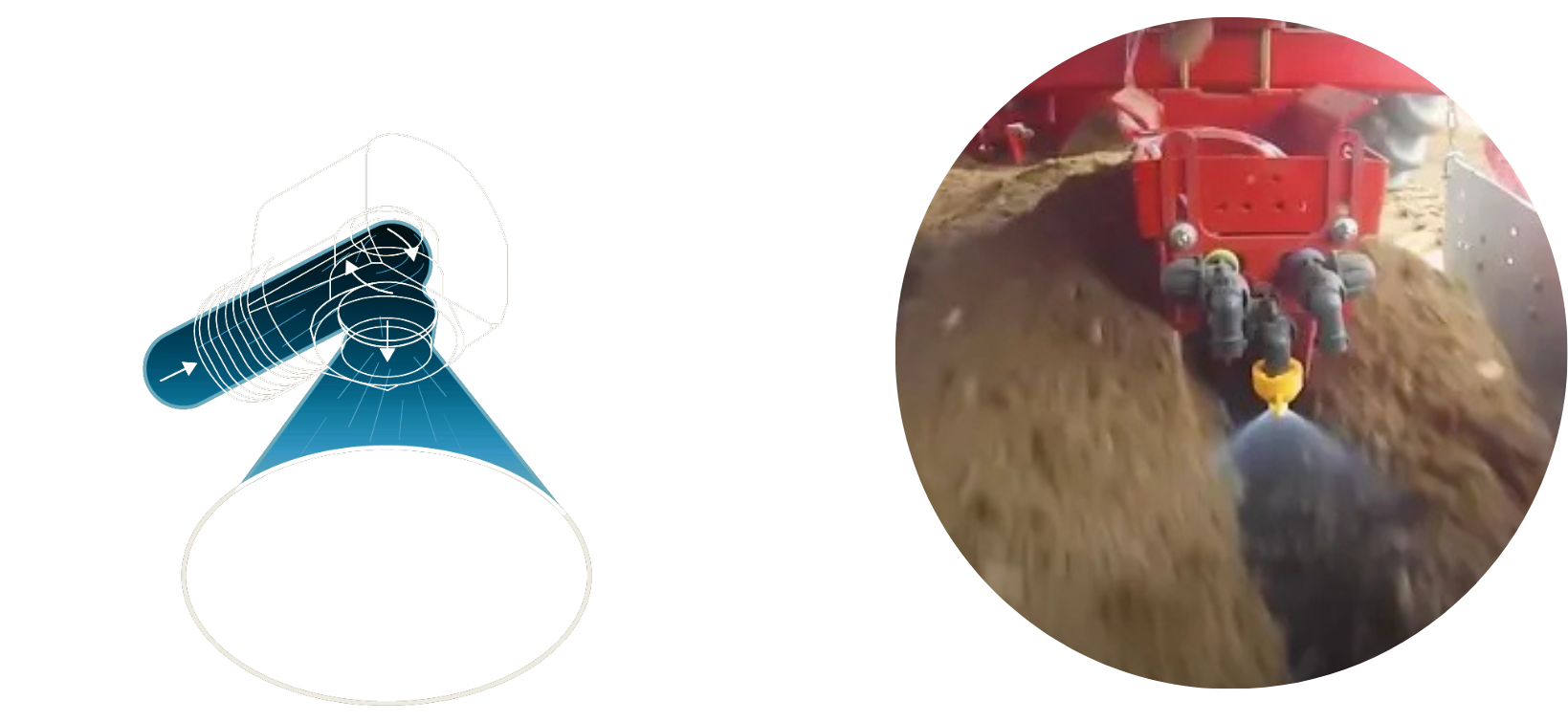
In furrow applications , flat fan or cone nozzles are often used, capable of generating a spray pattern that allows the spray solution to be distributed relatively uniformly in a small space.
Flat fan nozzles produce a more defined spray band, while cone nozzles create a more circular distribution. The choice between these two types often depends on the planter design and the intended coverage of the tuber and surrounding soil.
For RootDei Biocontrol® application we recommend using hollow cone nozzles
Regardless of the type of nozzle used, it is important to check that the spray pattern is homogeneous and that there are no obstructions or irregularities in the spray outlet.
Broth volume and treatment distribution
In furrow applications, the objective is not to cover a large plant surface, as in foliar treatments, but to distribute the treatment within the volume of soil surrounding the tuber.
For this reason, the volume of spray solution used and the way it is distributed within the furrow are factors that should be taken into account during the configuration of the application equipment.
System inspection, maintenance and cleaning
Before starting planting, it is advisable to check the condition of the planter’s spraying system.
Partial blockages in the nozzles, residues of products used in previous treatments, or the accumulation of sediment in the circuit can alter the distribution of the treatment within the furrow.
For this reason, it is advisable to perform a preliminary cleaning of the circuit , check the condition of the nozzles and ensure that all sprayers are working correctly before starting work in the field.
A basic check of the application system can prevent problems during planting and ensure that the treatment is distributed evenly across all lines of the machine.
Conclusions: an effective strategy integrated into the processes
RootDei Biocontrol®’s in-furrow application represents an easy and effective strategy to introduce the beneficial microorganism in crops optimal moment: plantation.
One of the main advantages of this system is that it does not require modifying the farmer’s usual work methodology . The product can be integrated into the normal planting process, using the machinery and application systems already present on the planter.
This article describes the technical aspects to consider to ensure correct application, from preparing the mixture to operating the agitation system and distributing the product in the furrow.
Effectiveness in controlling soilborne diseases and improving production
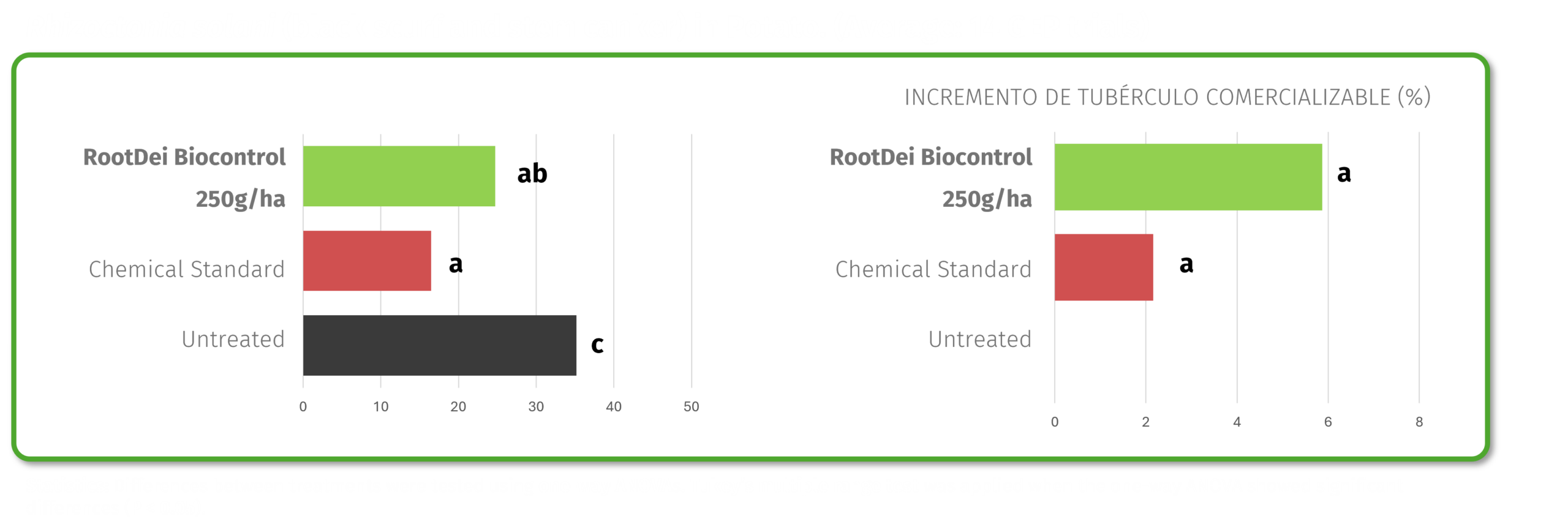
The results obtained in field trials show that this strategy allows achieving levels of effectiveness comparable to reference chemical fungicides , especially in the control of soil diseases such as Rhizoctonia solani .
All this with a single application at the time of planting and at a cost equivalent to conventional treatments , without the need to modify machinery or increase production costs.
An even better strategy combined with good genetics
This approach becomes even more interesting when combined with other agronomic strategies that contribute to improving the resilience of the production system.
As explained in Module I, selecting varieties with tolerance or resistance to some of the diseases that may affect the crop already provides a first level of protection. Another essential factor is to start with certified seed potatoes that are free from diseases and pests.
You can read the first blog post about resistant potato varieties at the banner link below.
MODULE I. BEYOND GENETICS:
Building a resilient production system begins with choosing disease-resistant varieties. However, successful potato cultivation also requires integrating other agronomic management and biocontrol strategies. We explain how in this article.
The combination of both strategies: genetic improvement and biocontrol, among other good practices, forms the basis of a management approach that allows farmers to progressively reduce their dependence on chemical interventions, while promoting a biologically healthier soil.
Long-term improvements in soil health
The effects of this strategy are not only observed during the growing season. In the long term, the benefits associated with improved soil biological activity become established after several crop cycles, contributing to more stable and sustainably productive systems over time.
Maintaining healthy soil allows for sustained crop yield in the long term, preventing soil degradation processes or loss of fertility that can lead to progressive declines in production.
Furthermore, from an operational standpoint, in-furrow application during planting offers another significant advantage: it integrates seamlessly into an operation that is already part of the sowing process. Many farmers apply localized treatments at this stage, so the incorporation of microorganisms can be carried out using the same machinery and workflow in the field.
Applying T34 Biocontrol® in-furrow at planting allows growers to leverage an existing field operation and position the product at a stage that is particularly conducive to its establishment and early root system colonization.
If you require further technical information, advice on application, or would like to carry out trials with RootDei Biocontrol® on your farm, please feel free to contact our technical team.
Module I. Beyond Genetics
Building a resilient potato production system requires combining genetics, agronomic management, and biocontrol.
MODULE II. TECHNICAL VIDEO
Discover in this video how to correctly apply RootDei Biocontrol® in-furrow during potato planting.


