

T34 Biocontrol® · Modes de Action
Why a chemical fungicide and a biofungicide can’t be described the same way
SECTION 1/3
When an agronomist assesses a conventional fungicide, the question of how it works usually has a short answer: it inhibits mitochondrial respiration, blocks sterol biosynthesis, disrupts cell division. One molecule, one function altered, one predictable effect. That answer fits on a single line of the datasheet.
Ask the same question about a product formulated with a living microorganism and the answer no longer fits on one line. A biological control agent behaves differently depending on the pathogen, the soil, the timing of application or the state of the crop. Just as no two chemical molecules are alike, no two microorganisms are alike either, even within the same genus and species. This is why registrations for biological plant protection products are strain-specific—down to the individual—and why managing them agronomically calls for criteria of its own.
Understanding modes of action in biological control is therefore a practical necessity before it is a theoretical one. It determines when to apply, what to expect, how to combine the product with other measures and which commercial claims deserve credit. This article sets that knowledge in order: what a mode of action actually is, how it differs from the target site it acts on, why the logic of biologicals cannot be carried over to chemicals without qualification and, beyond that, what significant differences exist between strains.
1. From molecules to living organism, and on to complementary actions: why the question changes
European plant health legislation has pushed the sector toward a management model that no longer rests on a single tool. Directive 2009/128/EC established the Community framework for the sustainable use of plant protection products, with integrated pest and disease management at its core: physical, cultural and crop-management methods, biological, genetic and biotechnological approaches and, as a last resort, synthetic chemistry.
Chemical control — only if the above fall short
01
Agronomic practices
Efficient water use, sound fertilization and resistant varieties. These reduce establishment and spread preventively.
02
Scouting and monitoring
Solid data to decide on. They also verify whether the strategies in place are working.
03
Mechanical and physical control
These kill the pest outright, block it or make the environment unsuitable for it.
04
Biological control
Natural enemies and microbial control agents. No resistance issues, and safe for wildlife and the environment.
That shift has brought a problem of language with it. The categories the sector learned to describe fungicides with—mode of action, binding site, resistance group—are applied to biologicals out of habit, even though what they describe is of an altogether different nature. A microorganism is not a molecule. Invisible to the naked eye though it may be, it is a considerably more complex biological system, able to respond to its surroundings, modulate its activity and deploy different processes at different points in the interaction.
The practical consequence is twofold. On the one hand, many field expectations rest on the wrong mental model: a biological is expected to deliver the fast, uniform response curve of a contact chemical. On the other hand, much of the sector’s technical communication blurs three notions that are worth keeping apart—the mode of action, the observable effect and the agronomic benefit.
2. What a mode of action is in a plant protection product
The mode of action of a plant protection product is the causal process by which an active substance produces a control effect on the target organism or on the disease in plants and crops.
causal
Observing a reduction in disease is not enough to attribute a mode of action.
active substance
A specific strain is as much an active substance as a synthetic molecule.
Two words in that definition are worth pausing on. The first is causal: observing a reduction in disease is not enough to attribute a mode of action. The second is active substance: under the European regulatory framework, a specific strain of a microorganism is as much an active substance as a synthetic molecule, and the same account of how it works is required of it.
The definition applies across the board to chemical products and microbial agents alike. In both cases the mode of action must describe a process that contributes causally to reducing disease, not simply a feature of the product, the crop or the production system. A formulation being stable, colonizing well or proving convenient to apply are valuable attributes, but they are not modes of action.
Mecanism
The biological process affected
Observable effect
Lower incidence in the field
Agronomic benefit
Yield and quality
Mode of action and target site are not the same thing
This is a common confusion and worth clearing up, because it has consequences for how resistance is interpreted.
The mode of action describes the biological process affected. The target site is the specific structure, molecule, enzyme or complex acted on within that process. FRAC, the Fungicide Resistance Action Committee, frames it this way: within each mode of action there are specific target sites—particular enzymes in a cellular process that fungicides bind to, for example.
FRAC illustrates the distinction with a familiar example: strobilurins (QoIs) and SDHIs share the same general mode of action, respiration inhibition, but act at different points in the respiratory chain complex III and complex II respectively. Same process affected different target sites.
Put briefly, for technical and general audiences alike:
– The mode of action is the process by which a product achieves disease control;
– The target site is the specific structure or molecule it acts on within that process.
Specific action and general action: two different logics
From this follows the operational difference that matters most to the field agronomist.
| Chemical plant protection product (specific action) | Biological plant protection product (general action) | |
|---|---|---|
| Nature of the action | Chemical plant protection product (specific action) A specific biological function of the pathogen is altered by an active substance | Biological plant protection product (general action) A functional process associated with a living organism |
| Target site | Chemical plant protection product (specific action) Often traceable to a specific molecule: an enzyme, a protein, a cellular complex | Biological plant protection product (general action) Hard to reduce to a single target; varies with the interaction |
| Variability | Chemical plant protection product (specific action) Relatively uniform behavior | Biological plant protection product (general action) Varies with the strain, the target organism (pathogen), the host plant and environmental conditions |
| Multiplicity | Chemical plant protection product (specific action) Usually, one principal mode of action | Biological plant protection product (general action) Microorganisms with multiple modes of action, working independently or together, are common |
| Resistance risk | Chemical plant protection product (specific action) Specificity can lead over time to the selection of resistant populations. The consequence is that the product stops working | Biological plant protection product (general action) The complexity of the action makes resistance harder to develop. Selection of resistant populations is unlikely |
This distinction does not call for two separate definitions of “mode of action.” It serves a more useful purpose: it avoids transferring the molecular model of chemical fungicides wholesale to biological control microorganisms, which is the source of much of the technical misunderstanding and of mismatched expectations in the field.
References:
- Fungicide Resistance Management | FRAC. (s. f.). FRAC. https://www.frac.info/fungicide-resistance-management
- European Parliament & Council of the European Union. (2009). Directive 2009/128/EC of the European Parliament and of the Council of 21 October 2009 establishing a framework for Community action to achieve the sustainable use of pesticides. Official Journal of the European Union, L 309, 71–86. https://eur-lex.europa.eu/legal-content/EN/TXT/?uri=CELEX:32009L0128
From the conceptual framework to the six modes of action in biological control
Defining what a mode of action is and distinguishing it from the target site settles the conceptual framework, but it leaves open the question that matters to the field agronomist: what those mechanisms are and how each one works.
The answer is not a short list. A biological control agent can work in two directions at once, on the pathogen and on the plant, deploying processes of a different nature in each: from direct parasitism of the pathogen’s hyphae to activation of the plant’s immune system; with the product applied at the root, for instance, and the response measured in the leaf.
The second module in this series walks through those six blocks, lays out the evidence behind them and identifies which are control mechanisms properly and which are better described as additional functional effects. It is a distinction that rarely appears in the sector’s technical communication, and it is what separates a rigorous account from a merely commercial one.
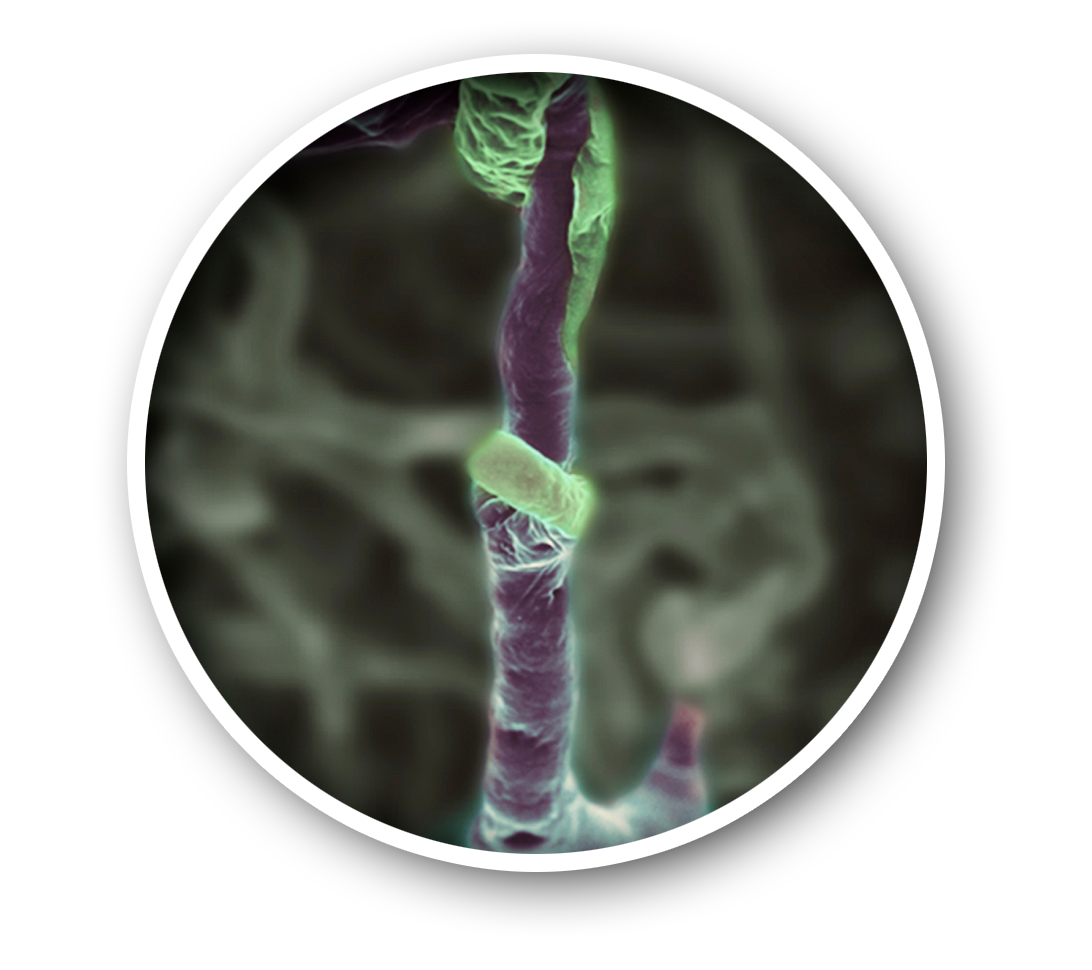
The six modes of action in biological control: how microorganisms act on the pathogen and on the plant
The six modes of action of biological control explained one by one: how microorganisms act on the pathogen and on the plant.
Continue exploring T. asperellum‘s modes of action
Return to the main Modes of Action page or explore the full information on T34 Biocontrol®.
Would you like to be notified when we publish Module II?
Leave us your email address and we’ll let you know when we publish the next chapter on the six mechanisms of action involved in biological control.
DATA PROTECTION
Basic information on the processing of your personal data
Data Controller:
Biocontrol Technologies S.L.
Purpose:
To manage your request and send you new educational and/or informational content by email.
Legal basis:
Your consent, given by accepting our Privacy Policy.
Recipients:
For internal use by Biocontrol Technologies. Your data will not be disclosed to third parties unless required by law or to service providers acting as data processors.
Your rights:
You may request access to, rectification or erasure of your data, restriction of processing, object to the processing of your data, request data portability, or withdraw your consent at any time by contacting
biocontrol@biocontroltech.com
For further information, please see our
Privacy Policy
Biocontrol Technologies, S.L. · NIF B63545446
Av. Madrid, 217 — 08014 Barcelona