Soilborne diseases · Phytophthoraspp. in strawberry
Phytophthora in Strawberry: Crown Rot, Disease Cycle and Symptoms
Crown, collar or basal rot.
What the pathogen is, how it survives and spreads, what symptoms it leaves on the plant, the crown and the fruit, and what conditions trigger infection in strawberry crops.
Strawberry is one of the most dynamic and profitable crops in global horticulture, with major economic importance in producing countries such as Spain, the United States, Turkey, Morocco and Mexico. However, its profitability is threatened by several soilborne diseases, most notably crown and root rot caused by Phytophthora spp., chiefly Phytophthora cactorum.
This pathogen causes significant losses in both nurseries and commercial fields. It can survive in the soil for years and spreads rapidly under excess water, which makes it a recurring problem for growers and crop advisors.
In this blog post, we explain what the pathogen is, its life cycle and which conditions favor infection, as well as the symptoms that help detect it in the field. Control with T34 Biocontrol® is covered in the next blog post in this series.
A pathogen known as the “plant destroyer”
What is Phytophthora spp.?
The genus Phytophthora comprises 223 described species (Abad et al., 2023) that attack vegetable, fruit, forest and ornamental crops. Its impact is especially severe in nurseries, where high plant density and frequent irrigation make it easy for the pathogen to spread.
The name comes from Greek and means “plant destroyer.” Anton de Bary described the genus in 1876 based on Phytophthora infestans, the causal agent of potato late blight.
It is a fungus-like pathogen that produces zoospores (flagellate spores) that can swim in soil water. That is why it is sometimes called a “water mold,” and why it spreads so quickly when there is excess moisture. Its cell wall is made of cellulose rather than chitin, which is why many conventional fungicides have no effect on it.
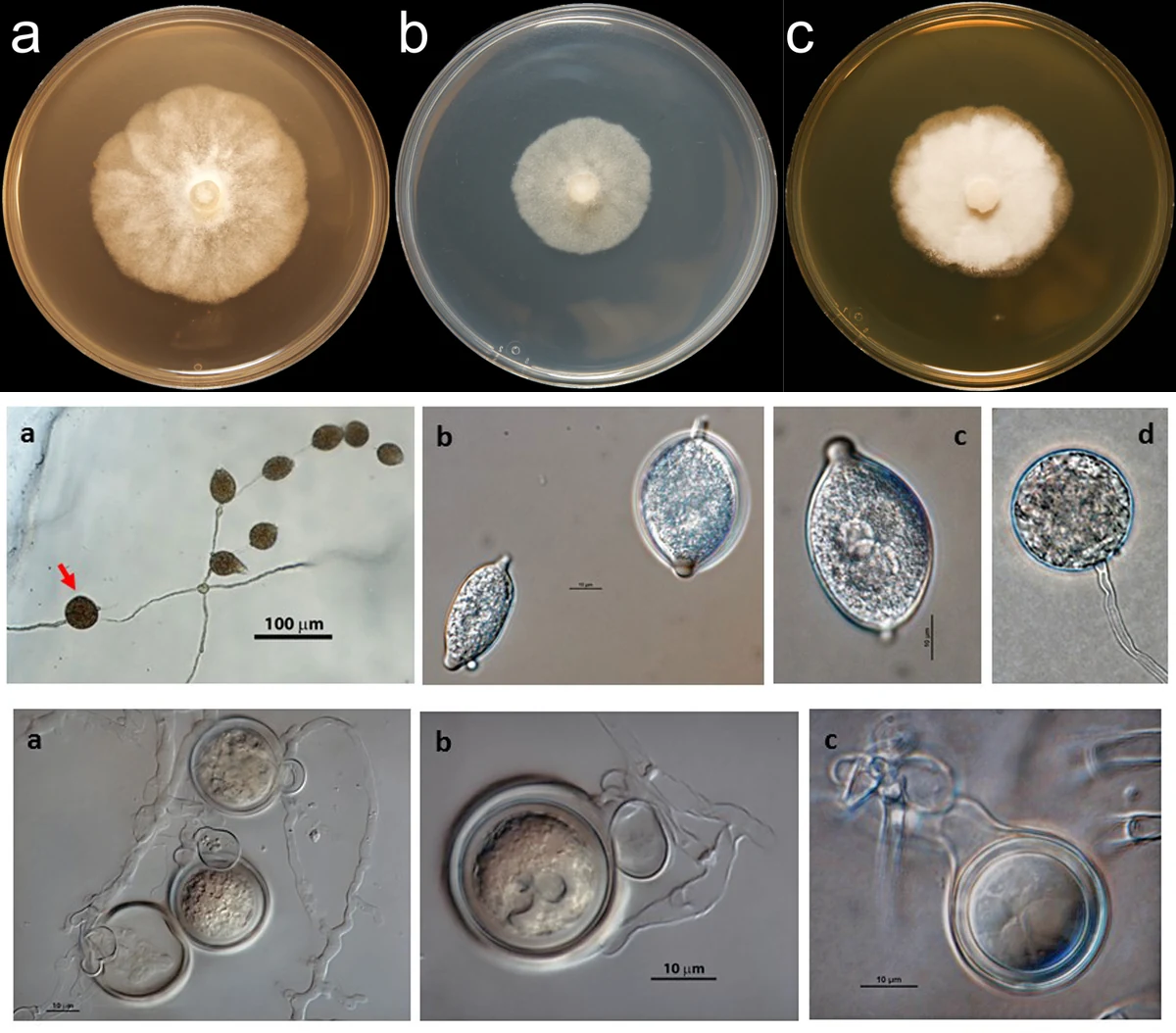
Phytophthora cactorum in culture and under the microscope. Top, 7-day-old colonies on three culture media; center, sporangia and chlamydospore; bottom, oogonia with antheridium and oospores. Images: K. Jennings, L. Knight, G. Abad and V. Brewster (USDA-APHIS-PPQ), in Abad et al. (2023), IDphy. Public domain.
Taxonomic classification
Kingdom
Stramenopila (SAR supergroup)
Phylum
Oomycota
Class
Peronosporomycetes (Oomycetes)
Order
Peronosporales
Family
Peronosporaceae
Genus
Phytophthora spp.
EPPO code
PHYTSP
223 described species, grouped into 16 phylogenetic clades. Source: Abad et al. (2023), Studies in Mycology 106: 259–348.
Global distribution · EPPO
Where the species affecting strawberry are found
P. cactorum is present on all five continents. P. fragariae is confined to temperate and cold regions. Click on a country or switch species.
OnlyP. cactorumOnlyP. fragariaeBoth species
Source: EPPO Global Database, distribution of Phytophthora cactorum (PHYTCC) and Phytophthora fragariae (PHYTFR), accessed October 2026. The map colors only countries with confirmed presence. Compiled by Biocontrol Technologies.
Disease cycle
How Phytophthora spp. develops
Phytophthora combines two cycles (polycyclic). The sexual cycle produces oospores that can survive in the soil for years; the asexual cycle multiplies the inoculum several times within a single season whenever free water is present. Choose a cycle, click on each phase of the diagram, or go through them step by step.
Diagram based on the cycle developed by Dr. Guillem Segarra for Biocontrol Technologies. Data: Abad et al. (2023), Studies in Mycology 106; Hudler (2013), Forest Phytophthoras 3(1); EPPO Global Database; Phytophthora Database; Ohio State University, PLPATH-FRU-34; AGES; Grove et al. (1985a, 1985b), Phytopathology 75; NC State Extension; UC IPM; Oregon State University; Forest Phytophthoras of the World.
Risk conditions
Conditions that favor Phytophthora
Water determines whether infection occurs; temperature determines which species is active and its aggressiveness; and soil determines how long water stays around the roots. Learning to read these three parameters lets you anticipate problems and guide your diagnosis to rule out false alarms.
The decisive factor
No free water, no infection
Zoospores, the infective spores, are released and move only under free-water conditions. That is why no favorable temperature is enough by itself: water is always required.
Saturated or waterlogged soilReleases zoospores and allows them to swim to the roots. This is the key condition for root and crown infection. (Ohio State; EPPO)
Splash from rain or overhead sprinkler irrigationCarries inoculum from the soil and from diseased fruit to healthy fruit, even if the fruit does not touch the ground. (NC State; UC IPM)
Runoff and drainage waterCarry the pathogen from one area of the field to another, and from infested fields to clean ones. (EPPO)
Temperature
The importance of soil temperature
Each species has its own processes, and each process its own temperature range. Move the slider from 0 to 35 °C to see which processes switch on and, in full color, which ones are at their optimum.
21°C
21°
05101520253035 °C
Below 2 °C: no activity
Neither species grows. The inoculum remains in the soil but does not progress.
Between 2 and 5 °C, growth begins
Everything moves very slowly, but root infection by red stele is already possible.
From 5 °C, soil inoculum awakens
P. fragariae oospores germinate, triggered by the presence of plant roots: inoculum that has been in the field for years becomes active.
Between 7 and 15 °C, maximum red stele risk
Zoospores are at peak activity and root infection is at its optimum. Cool, rainy periods are the worst-case scenario.
Between 15 and 17 °C, both species overlap
P. fragariae continues to infect roots and P. cactorum begins to sporulate on fruit.
From 17 °C, the fruit infection window opens
The infection range for green fruit begins and sporulation reaches its optimum. From this point on, watch overhead irrigation closely.
Between 20 and 25 °C, maximum fruit risk
More than one hour of fruit wetness infects over 80% of green fruit. Avoid overhead irrigation in this range.
Above 25 °C, only P. cactorum is active
P. fragariae stops infecting roots. If root damage appears in warm soil, the cause is probably something else.
Above 31 °C, growth stops
Neither species progresses, but the inoculum persists in the soil, waiting for water, favorable temperatures and the presence of plant roots.
P. cactorumCrown, root and fruit
Growth2–31 °C · optimum 25 °C—
A very wide range: it is active in both cool and warm areas. Temperature does not stop it; water does.(Ristaino, 2012)
Sporulation on fruit15–25 °C · optimum ≈20 °C—
With diseased fruit, mild weather and moisture, it forms new spores within a few days. (Grove et al., 1985b)
Green fruit infection17–25 °C · optimum 21 °C—
Peak-risk window: more than 1 h of fruit wetness infects over 80% of green fruit. (Grove et al., 1985a)
P. fragariaeRoot (red stele)
Growth3–27 °C · optimum 18 °C—
A cool-climate species, which is why it is rare where soils warm up, as in the southern Mediterranean. (EPPO)
Oospore germination5–20 °C · optimum 10–15 °C—
Soil inoculum awakens in cold, waterlogged soil. (EPPO)
Zoospore activity4–25 °C · peak 7–15 °C—
Cool, rainy periods carry the highest risk. (Ohio State)
Root infection3 to <25 °C · optimum 10–17 °C—
It does not infect at 25 °C. If roots become diseased in warm soil, the cause is probably something else. (EPPO)
To monitor
Green fruit, 17–25 °C and wet
This is the combination that triggers leather rot. When rain is forecast within this range, protect the fruit and avoid overhead irrigation.
To guide diagnosis
Cold soil or mild soil
Roots with a red core after a cold, waterlogged period point to red stele. Crown collapse at mild or warm temperatures points to P. cactorum. Laboratory testing confirms it.
To rule out
Above 25 °C, it is not red stele
P. fragariae does not infect at 25 °C. If damage appears in warm soil, look for another cause, starting with P. cactorum.
Soil and water management
Soil determines how long waterlogging lasts
Soil does not act on the pathogen directly: it acts through water. Anything that keeps water around the roots for longer increases the risk.
Texture and drainage
High risk
Heavy, poorly drained clay soils and low-lying areas of the field where water accumulates. This is where patches appear first. (AGES; Ohio State; EPPO)
Compaction
High risk
A compacted layer slows drainage and keeps water in the root zone. Breaking it up during field preparation reduces the risk. (UConn; NC State)
Organic matter
Reduces risk
Green manures and organic matter improve soil structure and drainage. (AGES; UConn)
Irrigation and mulching
Manageable
Overirrigation and overhead sprinklers favor the disease. Drip irrigation, raised beds and mulch reduce waterlogging and splash. (NC State; UC IPM)
Summary
Two species, two profiles
P. cactorum
P. fragariae
Disease
Crown rot and fruit leather rot
Red stele (red core root rot)
Climate
Cool and warm; water is the deciding factor
Cool; does not infect at 25 °C
Soil
Waterlogged, poorly drained or overirrigated
Clay, waterlogged and cold
Survival
Years in soil and in mummified fruit
12 years or more in soil
Entry
Nursery plants, even symptomless ones
Nursery plants, even symptomless ones
Status
Present worldwide
Regulated in the EU; absent from Spain according to EPPO
Sources: EPPO Global Database, Phytophthora fragariae; Ristaino (2012), Plant Disease 96; Grove et al. (1985a, 1985b), Phytopathology 75; AGES, Phytophthora cactorum on strawberry; NC State, Phytophthora crown rot and Leather rot of strawberry; UC IPM; Ohio State University, PLPATH-FRU-34; UConn Extension, Red stele disease of strawberries.
Critical stages
What to monitor at each stage of the season
Each crop stage has its own risks and symptoms. Choose the stage and click the hotspots on the plant to see what to look for in each part and how to check it in the field, so you can detect Phytophthora spp. before the damage becomes obvious.
Transplanting
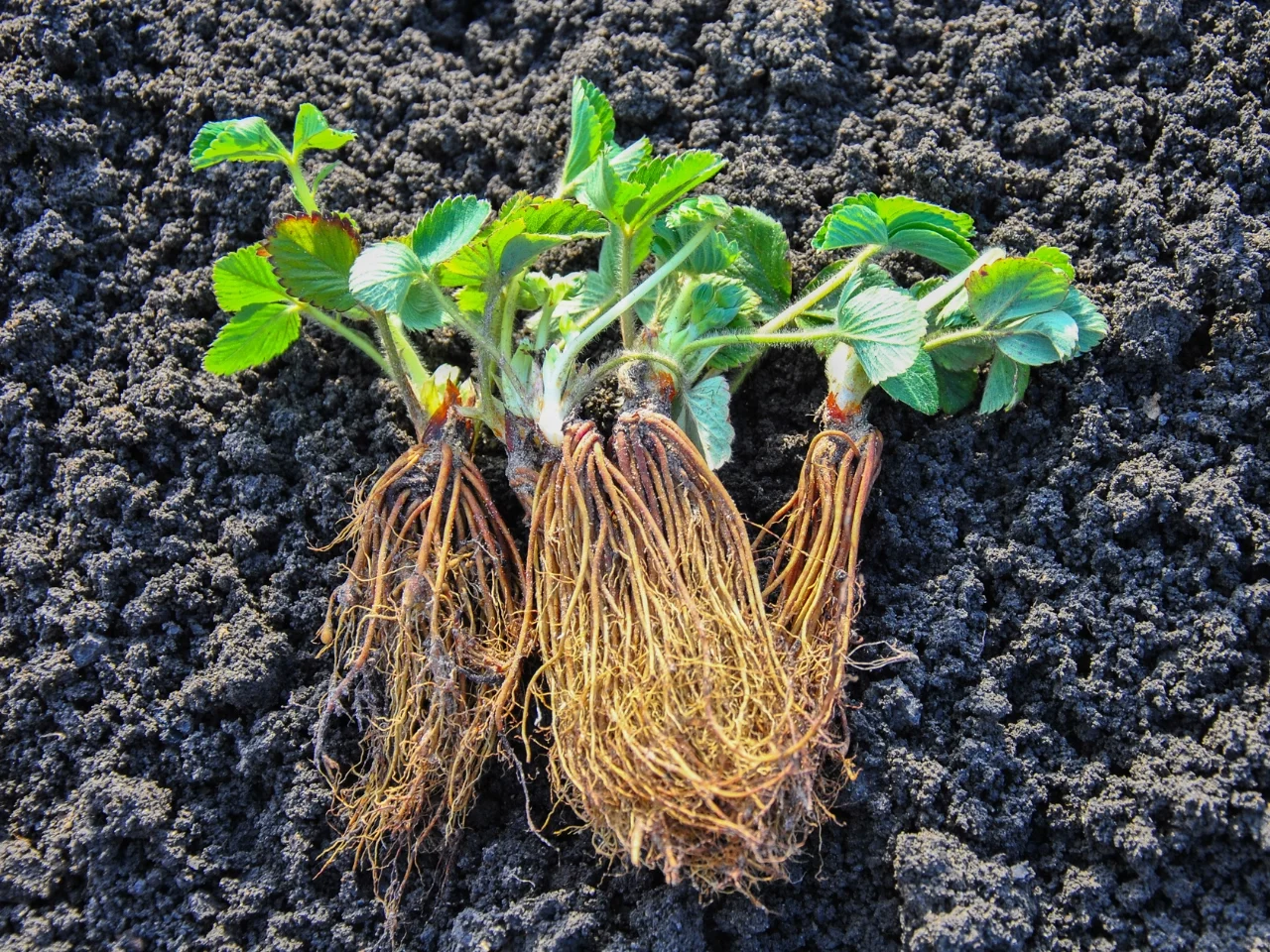
Nursery plants are the main entry route for the pathogen, and they can arrive infected without showing symptoms. That is why the first weeks after planting are the time to carefully inspect what has come into the farm.
What to look for
Young leavesPlants that remain small or have wilted young leaves.
RootsBlack roots right at the point where they join the crown.
How to check
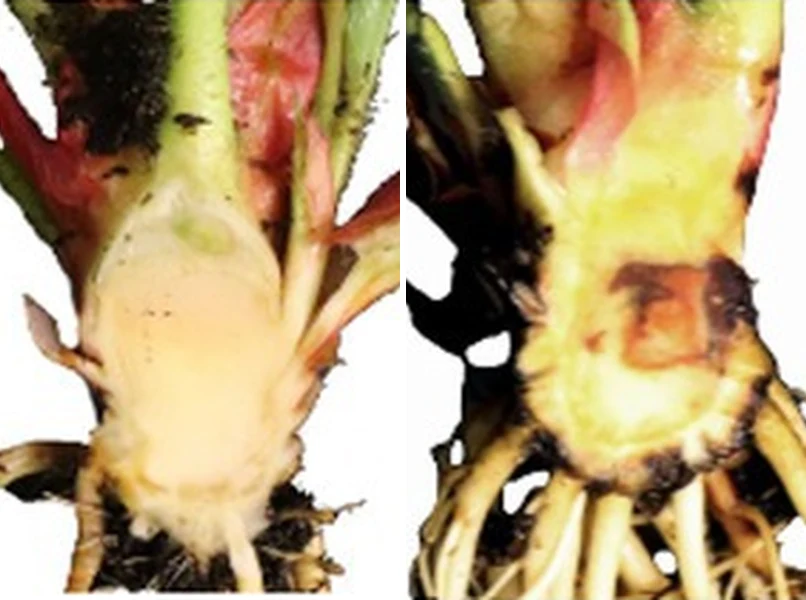
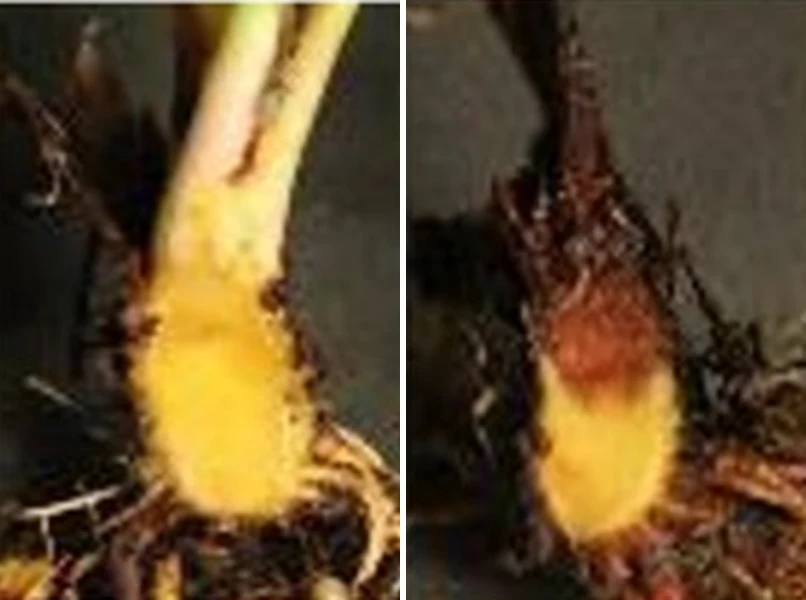
CrownPull up a suspect plant and cut the crown lengthwise. Early in the infection, the tissue looks water-soaked and light brown; later, reddish-brown and sharply separated from healthy tissue.
LaboratoryIf doubts remain, send a sample: PCR testing detects the pathogen even in roots that do not yet show symptoms.
What it looks like in the field
Healthy crownInfected crown
Crown cut lengthwise. Photos: Gogoi et al. (2023), Frontiers in Microbiology 14: 1214924, CC BY 4.0.
Cold-stored (frigo) plants
Cold-stored plants are highly susceptible to P. cactorum crown rot. If you plant transplants coming from cold storage, inspect them more frequently during the first few weeks.
What to look for
Heart leavesThey wilt, take on a bluish-green tint and then turn brown.
CrownAt advanced stages, the whole plant slumps and, when pulled, breaks off at the crown.
How to check
CrownCut it lengthwise: at advanced stages, the inside looks dark red.
RootsTo avoid confusing it with anthracnose (Colletotrichum spp.), check the roots attached to the crown. With Phytophthora they are black; with anthracnose they remain white or brown, and the crown looks firmer, cinnamon-colored and marbled.
What it looks like in the field
Healthy crownAdvanced rot
Crown cut lengthwise. Photos: Gogoi et al. (2023), Frontiers in Microbiology 14: 1214924, CC BY 4.0.
Flowering and harvest
With regrowth and fruit load, new crown collapses may appear, and rain or overhead sprinkler irrigation favors leather rot. In cool areas with waterlogged soil, this is also when red stele shows up.
What to look for
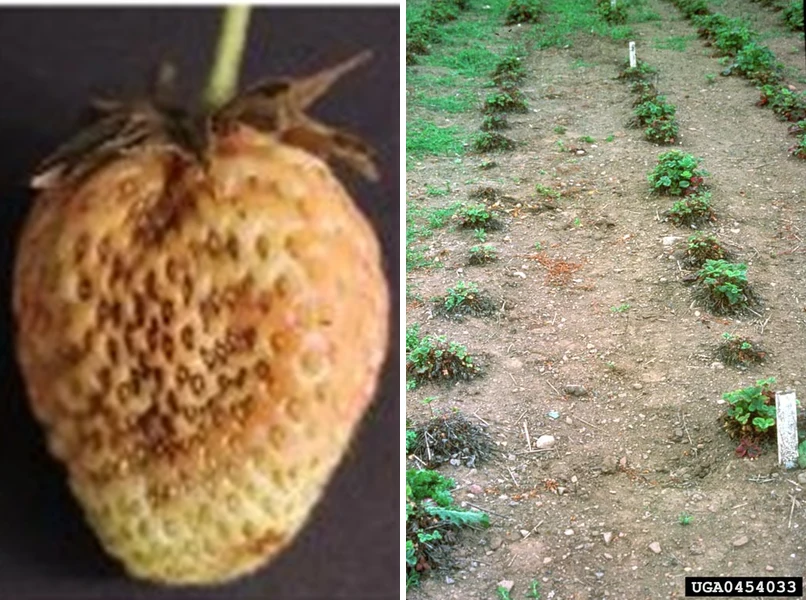
FruitFruit of any age with brown or purplish areas. Green fruit turns brown and leathery-hard; ripe fruit may change color only slightly, but becomes pale, with brown internal vascular strands and a bitter taste. Eventually the fruit dries out and mummifies. This is P. cactorum leather rot.
Leaves and plantPatches of stunted plants in low-lying or poorly drained areas, with young leaves showing a metallic bluish tint and older leaves turning yellow or red prematurely. With the first hot, dry weather, they wilt and die: this is P. fragariae red stele.
How to check
RootsCarefully dig up plants that are starting to wilt and split several roots lengthwise. A dark red stele is the telltale sign of red stele; in addition, the roots have almost no lateral feeder roots, the so-called “rat’s tail.”
WhenDo this during harvest: afterward, most infected roots have already rotted and the red color is hard to find.
What it looks like in the field
Leather rotRed stele in the field
Fruit: Gogoi et al. (2023), CC BY 4.0. Field: SCRI-Dundee, Bugwood.org.
Sources: AGES, Phytophthora cactorum on strawberry; NC State, Phytophthora crown rot of strawberry; UC IPM, Leather rot; Grove et al. (1985a, 1985b), Phytopathology 75; Ohio State University, PLPATH-FRU-34; EPPO Global Database, Phytophthora fragariae.
Strawberry and Berries · Keep reading
Now you know what to monitor. Next: how to protect your crop
01Next blog postIntegrated disease management, efficacy and application protocols
In the next blog post in this series, we will look at how to protect strawberry and other berries against Phytophthora spp. at each critical stage of the crop, combining agronomic measures and biological control with T34 Biocontrol®. In the meantime, find out how we work in these crops.
Abad, Z. G. et al. (2023). Phytophthora: taxonomic and phylogenetic revision of the genus.Studies in Mycology 106: 259–348.
Abad, Z. G.; Burgess, T. I.; Redford, A. J.; Bienapfl, J. C.; Srivastava, S.; Mathew, R.; Jennings, K. (2023). IDphy: an international online resource for molecular and morphological identification of Phytophthora.Plant Disease 107(4): 987–998.Available at: doi.org/10.1094/PDIS-02-22-0448-FE
Freshuelva (2025). Review of the 2024/25 Huelva berry season, reported in Portal Frutícola (July 11, 2025).Available at: portalfruticola.com/?p=600150
Gogoi, A.; Rossmann, S. L.; Lysøe, E.; Stensvand, A.; Brurberg, M. B. (2023). Genome analysis of Phytophthora cactorum strains associated with crown- and leather-rot in strawberry.Frontiers in Microbiology 14: 1214924.Available at: doi.org/10.3389/fmicb.2023.1214924
Grove, G. G.; Madden, L. V.; Ellis, M. A.; Schmitthenner, A. F. (1985a). Influence of temperature and wetness duration on infection of immature strawberry fruit by Phytophthora cactorum.Phytopathology 75: 165–169.
Grove, G. G.; Madden, L. V.; Ellis, M. A. (1985b). Influence of temperature and wetness duration on sporulation of Phytophthora cactorum on infected strawberry fruit.Phytopathology 75: 700–703.
Grove, G. G.; Ellis, M. A.; Madden, L. V.; Schmitthenner, A. F. (1985c). Overwinter survival of Phytophthora cactorum in infected strawberry fruit.Plant Disease 69: 514–515.
Hudler, G. W. (2013). Phytophthora cactorum.Forest Phytophthoras 3(1).
Junta de Andalucía, Observatory of Prices and Markets. Datos básicos Frutos Rojos: Fresa 2023/24 (Basic data on berries: strawberry 2023/24).Available at: juntadeandalucia.es/agriculturaypesca/observatorio
Biocontrol Technologies, S.L. · NIF B63545446 Av. Madrid, 217 — 08014 Barcelona
Gestionar consentimiento
Para ofrecer las mejores experiencias, utilizamos tecnologías como las cookies para almacenar y/o acceder a la información del dispositivo. El consentimiento de estas tecnologías nos permitirá procesar datos como el comportamiento de navegación o las identificaciones únicas en este sitio. No consentir o retirar el consentimiento, puede afectar negativamente a ciertas características y funciones.
Funcional
Always active
El almacenamiento o acceso técnico es estrictamente necesario para el propósito legítimo de permitir el uso de un servicio específico explícitamente solicitado por el abonado o usuario, o con el único propósito de llevar a cabo la transmisión de una comunicación a través de una red de comunicaciones electrónicas.
Preferencias
El almacenamiento o acceso técnico es necesario para la finalidad legítima de almacenar preferencias no solicitadas por el abonado o usuario.
Estadísticas
El almacenamiento o acceso técnico que es utilizado exclusivamente con fines estadísticos.El almacenamiento o acceso técnico que se utiliza exclusivamente con fines estadísticos anónimos. Sin un requerimiento, el cumplimiento voluntario por parte de tu proveedor de servicios de Internet, o los registros adicionales de un tercero, la información almacenada o recuperada sólo para este propósito no se puede utilizar para identificarte.
Marketing
El almacenamiento o acceso técnico es necesario para crear perfiles de usuario para enviar publicidad, o para rastrear al usuario en una web o en varias web con fines de marketing similares.